Transverse Wave Demonstration
Interactive Physics Simulation - Visualize Wave Motion and Particle Oscillation
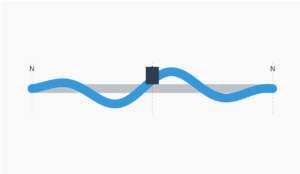
This transverse wave demonstration illustrates wave motion on a string, showing both a single pulse and continuous sinusoidal waves. In transverse waves, particle motion is perpendicular to the wave propagation direction—a fundamental concept in wave physics.
Adjust the amplitude and frequency to see how these parameters affect wave behavior and energy transfer along the medium.
Wave Simulation Canvas
Loading Transverse Wave Demonstration...
Transverse Wave Characteristics
- Wave propagation: Horizontal direction along the string
- Particle motion: Vertical oscillation perpendicular to wave direction
- Energy transfer: Travels along the string while particles oscillate in place
- Wave speed: Depends on string tension and linear mass density
- Amplitude: Maximum displacement of particles from equilibrium
- Frequency: Number of complete oscillations per second
Understanding Transverse Wave Demonstration
A transverse wave demonstration is one of the most fundamental experiments in physics education, illustrating how waves transfer energy through a medium. In this transverse wave demonstration, we observe that particle displacement occurs perpendicular to the direction of wave propagation—a defining characteristic of transverse waves.
What is a Transverse Wave?
A transverse wave is a wave in which particles of the medium oscillate perpendicular to the direction of wave travel. Common examples include waves on a string, electromagnetic waves (light), and seismic S-waves. This transverse wave demonstration uses a string to visualize these principles clearly.
Key Features of This Transverse Wave Demonstration
This interactive transverse wave demonstration allows you to explore:
- Single Pulse Mode: Shows a localized disturbance traveling along the string, demonstrating how energy propagates through the medium
- Continuous Wave Mode: Displays periodic sinusoidal waves with adjustable amplitude and frequency
- Particle Motion Indicators: Blue markers show individual particle oscillation perpendicular to wave direction
- Wave Direction Arrows: Visual indicators clarify the distinction between wave propagation and particle motion
Wave Parameters in Transverse Wave Demonstration
Understanding wave parameters is crucial for mastering wave physics. This transverse wave demonstration lets you adjust:
- Amplitude (A): Maximum displacement of particles from equilibrium position. Larger amplitude means more energy in the wave
- Frequency (f): Number of complete oscillations per second, measured in Hertz (Hz). Higher frequency means more oscillations in a given time
- Wavelength (λ): Distance between consecutive crests or troughs, related to frequency and wave speed by λ = v/f
- Wave Speed (v): Rate at which the wave pattern moves through the medium
Physics Behind Transverse Waves
In this transverse wave demonstration, the wave equation governs motion:
y(x,t) = A sin(kx - ωt)
Where:
- y = particle displacement
- A = amplitude
- k = wave number (2π/λ)
- ω = angular frequency (2πf)
- x = position along string
- t = time
Applications of Transverse Wave Demonstrations
Understanding transverse waves through demonstrations like this is essential for:
- Seismology: S-waves (secondary waves) are transverse waves that travel through Earth
- Electromagnetics: Light and radio waves are transverse electromagnetic waves
- Musical Instruments: Vibrating strings produce transverse standing waves
- Engineering: Understanding wave behavior in structural mechanics and materials science
- Quantum Mechanics: Photons and other particles exhibit wave-like transverse properties
Energy Transfer in Transverse Waves
A key insight from this transverse wave demonstration is that while particles oscillate perpendicular to wave direction, energy travels along the wave. The rate of energy transfer depends on:
- Wave amplitude (energy ∝ A²)
- Frequency (energy ∝ f²)
- Medium properties (tension and density for strings)
Educational Value of Transverse Wave Demonstrations
This interactive transverse wave demonstration provides several learning benefits:
- Visual understanding of perpendicular particle motion vs. wave propagation
- Real-time observation of amplitude and frequency effects
- Clear distinction between pulse and continuous wave behavior
- Foundation for understanding more complex wave phenomena like interference and standing waves
Comparing Transverse and Longitudinal Waves
While this transverse wave demonstration shows perpendicular motion, it's important to contrast with longitudinal waves:
- Transverse waves: Particle motion ⊥ wave direction (strings, light, S-waves)
- Longitudinal waves: Particle motion ∥ wave direction (sound, P-waves, compression springs)
Use this transverse wave demonstration to explore wave fundamentals and develop intuition about how waves behave in nature and technology.