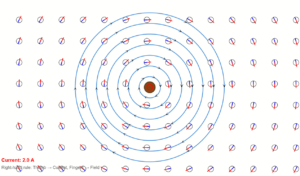
Electromagnetic Induction Simulator
Explore Faraday's and Lenz's laws with interactive magnetic field demonstrations
EMF
0.00 mV
Current
0.00 µA
Flux
0.00 µWb
Magnet Controls
Coil Configuration
Application Mode
Live Measurements
Induced EMF
0.00 mV
Induced Current
0.00 µA
Magnetic Flux
0.00 µWb
Power
0.00 nW
Physics Formulas
Faraday's Law
ε = -N(dΦ/dt)
0 = -100(0/0)
Induced EMF equals negative rate of flux change times turns
Magnetic Flux
Φ = BA cosθ
0 = 0.5×0×cos(0°)
Flux through coil area perpendicular to field
Lenz's Law
Direction opposes change
Current flows counterclockwise
Induced current opposes the change causing it
Power Dissipation
P = I²R
0 = (0)²×10
Power dissipated as heat in coil resistance
EMF Waveform Analysis
Frequency: 0.00 Hz |
Peak EMF: 0.00 mV
Applications & Theory
Electric Generators
Rotating magnets or coils in power plants generate electricity through electromagnetic induction. The mechanical energy of rotation is converted to electrical energy.
Example: A 1000-turn coil in a 0.5T field rotating at 60 Hz generates ~188V peak EMF.
Transformers
Changing current in the primary coil induces voltage in the secondary coil. Voltage ratio equals turns ratio: V₂/V₁ = N₂/N₁.
Example: 100:1000 turn ratio gives 10x voltage step-up.
Lenz's Law Effects
The induced current creates a magnetic field that opposes the change. This is why moving a magnet through a coil requires force against electromagnetic braking.
Application: Eddy current brakes in trains and elevators.
Wireless Charging
Modern wireless chargers use electromagnetic induction to transfer power without physical contact. The charging pad contains a coil that creates a changing magnetic field.
Efficiency: Typically 80-90% for close-coupled systems.