Astronaut and Spaceship Physics Simulation
Demonstrating Newton's First Law of Motion in Space
Simulation Overview
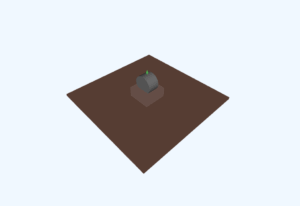
This interactive simulation demonstrates the physics principles involved when an astronaut becomes separated from an accelerating spaceship in interstellar space, as described in Newton's First Law of Motion.
Simulation Controls
Example
Question:
An astronaut accidentally gets separated out of his small spaceship accelerating in interstellar space at a constant rate of \(100\,\mathrm{m\,s^{-2}}\).
What is the acceleration of the astronaut the instant after he is outside the spaceship?
(Assume that there are no nearby stars to exert gravitational force on him.)
Solution:
Since there are no nearby stars to exert gravitational force on him and the spaceship's gravitational pull is negligible, the net force acting on the astronaut, once he is out of the spaceship, is zero.
By the first law of motion, the acceleration of the astronaut is zero.
Physics Principles Demonstrated
Newton's First Law of Motion
An object in motion stays in motion with the same speed and in the same direction unless acted upon by an unbalanced force. In this simulation, the astronaut continues at constant velocity after separation because no forces act on them.
Acceleration and Force
The spaceship accelerates because its engines provide constant thrust (F=ma). The astronaut has zero acceleration because no forces act on them after separation (F=0 ⇒ a=0).
Key Observation
In the reference frame of the spaceship, it appears that the astronaut is accelerating away, but this is actually because the spaceship is accelerating. In an inertial (non-accelerating) reference frame, the astronaut has zero acceleration.