Projectile Range Symmetry
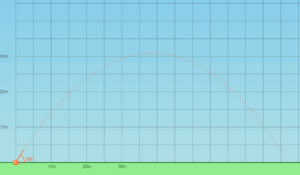
This interactive simulation demonstrates Galileo's remarkable discovery that projectiles launched at complementary angles produce identical ranges. When you throw an object at 60° or 30° (both 15° away from 45°), it lands at the same distance. This symmetry occurs because angles equally above and below 45° share the same horizontal range, though they differ in flight time and maximum height. Understanding this principle helps students grasp fundamental physics concepts about projectile motion, velocity components, and optimal launch angles in real-world applications like sports and engineering.
Understanding the Physics
The Range Formula: The horizontal distance a projectile travels is given by R = (v₀² × sin(2θ)) / g, where v₀ is initial velocity, θ is launch angle, and g is gravity (9.8 m/s²).
Why Equal Ranges? For complementary angles (45° + α) and (45° - α), the term sin(2θ) produces the same value. This is because sin(90° + 2α) = sin(90° - 2α) = cos(2α), resulting in identical ranges.
Key Observations:
- Maximum range occurs at exactly 45° launch angle
- Higher angles result in longer flight times but same range
- Lower angles have shorter flight times with identical range
- This symmetry is independent of initial velocity