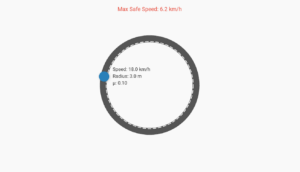
Train Acceleration with Friction
Example 4.7
Determine the maximum acceleration of the train in which a box lying on its floor will remain stationary, given that the coefficient of static friction between the box and the train's floor is 0.15.
Example
Question:
Determine the maximum acceleration of the train in which a box lying on its floor will remain stationary, given that the coefficient of static friction between the box and the train’s floor is \(0.15\).
Solution:
Since the acceleration of the box is due to the static friction,
\[
ma = f_s \leq \mu_s N = \mu_s mg
\]
i.e.
\[
a \leq \mu_s g
\]
\[
\boxed{a_{\max} = \mu_s g = 0.15 \times 10\,\mathrm{m\,s^{-2}} = 1.5\,\mathrm{m\,s^{-2}}}
\]
Friction coefficient (μ) = 0.15
Gravity (g) = 10 m/s²
amax = μg
= 0.15 × 10
= 1.5 m/s²
a ≤ μg
0.0 ≤ 1.5
Physics Explanation
The box remains stationary when the static friction can provide enough force to match the train's acceleration.
Required force (F) = ma
For no slipping: fs ≥ F ⇒ μmg ≥ ma
⇒ a ≤ μg
In This Example:
If the train accelerates faster than 1.5 m/s², the box will begin to slip backward.