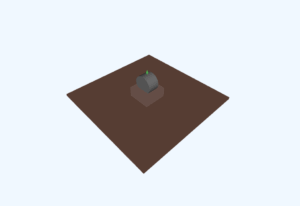
Cyclist Cornering Physics Simulation
Cyclist Parameters
Road Conditions
Example
Question:
A cyclist speeding at \(18\,\mathrm{km/h}\) on a level road takes a sharp circular turn of radius \(3\,\mathrm{m}\) without reducing the speed. The coefficient of static friction between the tyres and the road is \(0.1\). Will the cyclist slip while taking the turn?
Solution:
On an unbanked road, frictional force alone can provide the centripetal force needed to keep the cyclist moving on a circular path without slipping.
If the speed is too high, or the turn is too sharp (small radius), then friction is insufficient.
The condition for the cyclist not to slip is:
\[
v^2 \leq \mu_s Rg
\]
Where \(R = 3\,\mathrm{m}\), \(g = 9.8\,\mathrm{m\,s^{-2}}\), \(\mu_s = 0.1\):
\[
\mu_s Rg = 0.1 \times 3 \times 9.8 = 2.94\,\mathrm{m}^2\mathrm{s}^{-2}
\]
The cyclist’s speed: \(v = 18\,\mathrm{km/h} = 5\,\mathrm{m/s}\),
\[
v^2 = 25\,\mathrm{m}^2\,\mathrm{s}^{-2}
\]
This does **not** satisfy the condition.
The cyclist will slip while taking the circular turn.
The condition for the cyclist not to slip is given by:
Calculating...
Adjust the parameters to see if the cyclist will slip