3D Static Friction on an Inclined Plane
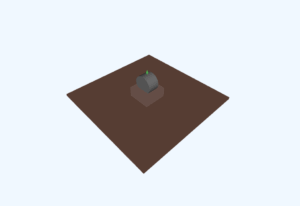
This 3D simulation demonstrates how the coefficient of static friction (μs) can be determined by finding the angle at which a block just begins to slide.
Example
Question:
A mass of \(4\,\mathrm{kg}\) rests on a horizontal plane. The plane is gradually inclined until at an angle \(\theta = 15^\circ\) with the horizontal, the mass just begins to slide.
What is the coefficient of static friction between the block and the surface?
Solution:
The forces acting on a block of mass \(m\) at rest on an inclined plane are:
(i) the weight \(mg\) acting vertically downwards,
(ii) the normal force \(N\) of the plane on the block,
(iii) the static frictional force \(f_s\) opposing impending motion.
Resolving the weight along the shown directions:
\[
mg \sin\theta = f_s,\qquad mg \cos\theta = N
\]
As \(\theta\) increases, \(f_s\) increases until at \(\theta = \theta_{\text{max}}\), \(f_s\) achieves its maximum value, \(f_{s,\text{max}} = \mu_s N\).
Therefore,
\[
\tan \theta_{\text{max}} = \mu_s \qquad \text{or} \qquad \theta_{\text{max}} = \tan^{-1} \mu_s
\]
For \(\theta_{\text{max}} = 15^\circ\):
\[
\mu_s = \tan 15^\circ = 0.27
\]
This value is independent of the mass of the block.
Physics Explanation:
When a block rests on an inclined plane, three forces act on it:
- Weight (mg) acting vertically downward
- Normal force (N) perpendicular to the plane
- Static friction (fs) parallel to the plane opposing motion
We can resolve the weight into two components:
At equilibrium, just before sliding begins:
N = mg cosθ
Therefore: μs = tanθmax
In this example from the textbook: