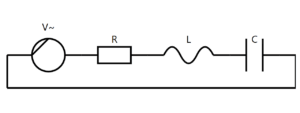
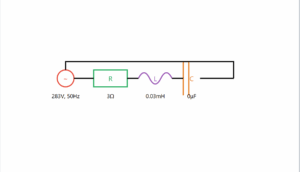
Inductive Reactance and Bulb Brightness
This simulation demonstrates how inserting an iron rod into an inductor affects a light bulb's brightness in an AC circuit, as described in Example 7.5.
Example
Question:
A light bulb and an open coil inductor are connected to an AC source through a key as shown in Fig. 7.9.
The switch is closed and after some time, an iron rod is inserted into the interior of the inductor. The glow of the light bulb (a) increases; (b) decreases; (c) is unchanged, as the iron rod is inserted. Give your answer with reasons.
Solution:
As the iron rod is inserted, the magnetic field inside the coil magnetizes the iron, increasing the magnetic field inside. Hence, the coil's inductance increases. Consequently, the inductive reactance also increases. As a result, a larger fraction of the applied AC voltage appears across the inductor, leaving less voltage across the bulb. Therefore, the glow of the light bulb decreases.
Inductance (L)
Without iron core
Inductive Reactance (XL)
XL = 2πfL
Bulb Voltage
Vbulb = Vsource × (Rbulb/Z)
Inductor Voltage
VL = Vsource × (XL/Z)
Explanation (from Example 7.5):
When an iron rod is inserted into the inductor:
- The magnetic field inside the coil increases, magnetizing the iron
- This increases the inductance (L) of the coil
- The inductive reactance (XL = 2πfL) increases
- More voltage drops across the inductor, leaving less for the bulb
- As a result, the bulb's brightness decreases
Key parameters: AC source = 220V, 50Hz; Bulb resistance ≈ 31.4Ω (matched to initial XL)