Electromagnetic Induction Simulation
Example 6.5: Faraday's Law Demonstrations
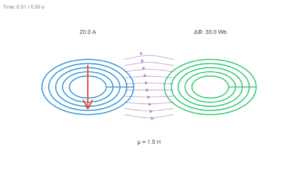
The induced electromotive force (emf) in any closed circuit is equal to the negative of the time rate of change of the magnetic flux through the circuit.
Faraday's law relates to changing magnetic flux, not electric flux. This demonstrates that electric and magnetic fields have different effects on charge motion.
The rectangular loop exits the field at a constant rate (dA/dt is constant), while the circular loop's area changes non-linearly as it exits, resulting in varying emf.
Example
Question:
(a) A closed loop is held stationary in the magnetic field between the north and south poles of two permanent magnets held fixed. Can we hope to generate current in the loop by using very strong magnets?
(b) A closed loop moves normal to the constant electric field between the plates of a large capacitor. Is a current induced in the loop (i) when wholly inside the region between the plates? (ii) when partially outside?
(c) A rectangular loop and a circular loop are moving out of a uniform magnetic field (Fig. 6.8) to a field-free region with constant velocity \(\mathbf{v}\). In which loop is the induced emf constant during the passage out of the field region?
(d) Predict the polarity of the capacitor in the situation described by Fig. 6.9.
Solution:
(a) No. However strong the magnet, current can be induced only by changing magnetic flux through the loop.
(b) No current is induced in either case. Current cannot be induced by changing electric flux.
(c) Induced emf is constant only for the rectangular loop; not for the circular loop (area rate of change not constant for circle).
(d) Polarity: Plate 'A' will be positive with respect to plate 'B' in the capacitor.
This is determined by Lenz's Law, which states that the direction of induced current will oppose the change in magnetic flux that produced it. The current flows in a direction to create a magnetic field opposing the increasing flux through the loop.