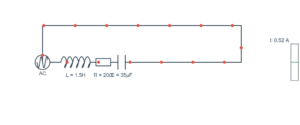
LC Oscillation Circuit Simulation
Interactive demonstration of free oscillations in an LC circuit with energy conservation
Simulation Controls
Circuit Parameters
Animation Control
Energy Analysis
Electric Energy (Capacitor)
Magnetic Energy (Inductor)
Total Energy
Real-time Waveforms
Understanding LC Oscillations
Energy Conservation
In an ideal LC circuit, total energy is conserved. Energy oscillates between electric energy stored in the capacitor and magnetic energy stored in the inductor.
Natural Frequency
The natural frequency of LC oscillations depends only on the inductance L and capacitance C values, not on the initial charge or energy.
Phase Relationships
Charge Q(t) and capacitor voltage V_C(t) are in phase. Current I(t) leads charge by 90°, being maximum when charge is zero.
Voltage Relationship
At any instant, the sum of voltages across the inductor and capacitor equals zero, since there is no external voltage source.
Mechanical Analogy
LC oscillations are analogous to a mass-spring system: L ↔ mass, 1/C ↔ spring constant, Q ↔ displacement, I ↔ velocity.
• Inductor stores magnetic energy (like kinetic energy)
• Current flows back and forth (like oscillating motion)
• Natural frequency is determined by L and C
Problem 7.6 Solution
For the circuit with L = 27mH and C = 30µF: