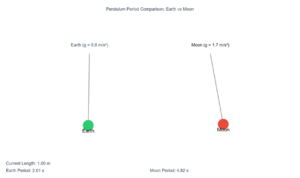
Pendulum Physics Simulation
Exploring simple harmonic motion in pendulums under various conditions
1.0 m
1.0 kg
15°
Question (a): Mass Independence of Pendulum Period
Why is the time period of a simple pendulum independent of the mass of the bob?
Explanation
The time period of a simple pendulum is given by:
T = 2π√(l/g)
This shows no dependence on mass because:
- The restoring force (F = -mg sinθ) is proportional to mass
- The inertia (resistance to motion) is also proportional to mass
- These two effects cancel each other out
Try changing the mass in the simulation - you'll see the period remains constant!
Question (b): Large Angle Oscillations
Why does the period increase for larger angles of oscillation?
Explanation
For small angles (θ < 15°), we approximate sinθ ≈ θ, giving:
F = -mgθ = -mg(x/l)
This results in simple harmonic motion with period:
T = 2π√(l/g)
For larger angles:
- sinθ > θ, so the restoring force is weaker than the linear approximation
- This effectively reduces the "g" in the period formula
- Resulting in a longer period: T > 2π√(l/g)
Try increasing the initial angle in the simulation to observe this effect!
Questions (c) & (d): Free-Fall Scenarios
What happens to a wristwatch and pendulum in free-fall?
Explanation
Wristwatch in free-fall:
- Mechanical watches use springs, not gravity
- They keep accurate time regardless of free-fall
- Demonstrated by the working watch in the right simulation
Pendulum in free-falling cabin:
- The effective gravity becomes g - g = 0
- No restoring force acts on the pendulum
- Frequency becomes zero (no oscillation)
- Select "Free-Falling Cabin" scenario to observe
Theoretical Period
2.01
seconds
Measured Period
0.00
seconds
Oscillation Count
0
cycles
Effective Gravity
9.81
m/s²