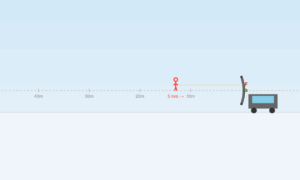
Spherical Surface Refraction
Interactive demonstration of Example 9.5 - Light refraction at curved air-glass interface
Textbook Setup
Example
Question:
Light from a point source in air falls on a spherical glass surface (\( n = 1.5 \), radius of curvature \( = 20~\text{cm} \)). The distance of the light source from the glass surface is \( 100~\text{cm} \). At what position is the image formed?
Solution:
Using the equation:
\[
\frac{n_2}{v} + \frac{n_1}{u} = \frac{n_2 - n_1}{R}
\]
Given: \( u = -100~\text{cm} \), \( R = +20~\text{cm} \), \( n_1 = 1 \), \( n_2 = 1.5 \).
Substitute values:
\[
\frac{1.5}{v} + \frac{1}{-100} = \frac{0.5}{20}
\]
\[
\frac{1.5}{v} - \frac{1}{100} = \frac{1}{40}
\]
Solve:
\[
\frac{1.5}{v} = \frac{1}{40} + \frac{1}{100} = \frac{5}{200} = \frac{1}{40}
\]
So,
\[
v = +100~\text{cm}
\]
The image is formed at a distance of 100 cm from the glass surface, in the direction of incident light.
Interactive Parameters
Real-time Calculations
Physics Insights
Refraction at Curved Surface
n₂/v - n₁/u = (n₂ - n₁)/R
Where n₁ = 1.0 (air), n₂ = 1.5 (glass)
1.5/100 - 1.0/(-100) = (1.5-1.0)/20
Snell's Law at Each Point
Light bends at each point on the curved surface according to n₁sin(θ₁) = n₂sin(θ₂). The curved geometry causes rays to converge or diverge.
Sign Conventions
Object distances: Negative for real objects
Image distances: Positive when in denser medium
Radius: Positive for center on exit side
Applications
• Eyeglasses: Curved lenses correct vision
• Camera lenses: Multiple curved surfaces focus light
• Optical fibers: Step-index profiles guide light
• Water droplets: Form rainbows through refraction
Example 9.5 Solution
Given Values
n₁ = 1.0 (air), n₂ = 1.5 (glass)
R = +20 cm (convex surface), u = -100 cm
Apply Refraction Equation
n₂/v - n₁/u = (n₂ - n₁)/R
1.5/v - 1.0/(-100) = (1.5 - 1.0)/20
Solve for Image Distance
1.5/v + 0.01 = 0.025
1.5/v = 0.015
v = +100 cm
Physical Interpretation
Real image forms 100 cm inside the glass medium. The curved interface acts as a converging element, focusing the light from the point source.