Faraday's Electromagnetic Induction Experiment
Example 6.1: Galvanometer Deflection and Current Detection
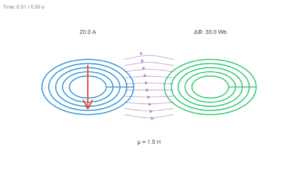
This interactive simulation demonstrates Michael Faraday's groundbreaking experiment that established the principle of electromagnetic induction. When the magnetic field through coil C₁ changes, it induces a current in coil C₂ that can be detected by either a galvanometer or a bulb.
\[\mathcal{E} = -\frac{d\Phi_B}{dt}\]
Where \(\mathcal{E}\) is the electromotive force (EMF) and \(\Phi_B\) is the magnetic flux.
Example
Question:
(a) What would you do to obtain a large deflection of the galvanometer?
(b) How would you demonstrate the presence of an induced current in the absence of a galvanometer?
Solution:
(a) To obtain a large deflection, you can:
(i) Use a rod made of soft iron inside coil \(C_2\),
(ii) Connect the coil to a powerful battery,
(iii) Move the arrangement rapidly towards the test coil \(C_1\).
(b) Replace the galvanometer with a small bulb (like a torch bulb). Relative motion between the coils will cause the bulb to glow and thus demonstrate the presence of an induced current.
In experimental physics one must learn to innovate. Michael Faraday, one of the best experimentalists ever, was legendary for his innovative skills.
(a) Large deflection can be obtained by:
- Using a soft iron rod in coil C₂ (increases magnetic flux Φ)
- Connecting to a powerful battery (creates stronger initial magnetic field)
- Moving the arrangement rapidly (increases rate of change of flux dΦ/dt)
(b) Without galvanometer, a small bulb can be used that glows when current is induced, demonstrating the practical application of electromagnetic induction.
Faraday's innovative approaches in this experiment revolutionized our understanding of electromagnetism and paved the way for modern electrical technology.