Electric Dipole Field Simulation
Visualize and calculate electric fields around dipole configurations
Interactive Simulation
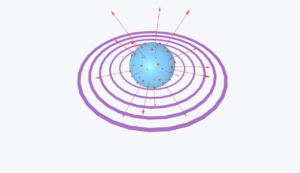
This simulation visualizes the electric field around a dipole (±10 μC charges). Click "Calculate Field" to see the electric field at the selected point.
Example
Question:
Two charges \( \pm 10\,\mu\text{C} \) are placed \( 5.0\,\text{mm} \) apart. Determine the electric field at (a) a point \( P \) on the axis of the dipole \( 15\,\text{cm} \) away from its centre \( O \) on the side of the positive charge, as shown in Fig. 1.18(a), and (b) a point \( Q \), \( 15\,\text{cm} \) away from \( O \) on a line passing through \( O \) and normal to the axis of the dipole, as shown in Fig. 1.18(b).
Solution:
(a) Field at \( P \) due to charge \( +10\,\mu\text{C} \):
\[
E_{BP} = \frac{10^{-5}\,\text{C}}{4\pi(8.854\times10^{-12}\,\text{C}^2\,\text{N}^{-1}\,\text{m}^{-2}) \times (15+0.025)\times10^{-2}\,\text{m}^2}
= 4.13 \times 10^6\,\text{N\,C}^{-1}
\]
along BP.
Field at \( P \) due to charge \( -10\,\mu\text{C} \):
\[
E_{AP} = \frac{10^{-5}\,\text{C}}{4\pi(8.854\times10^{-12}\,\text{C}^2\,\text{N}^{-1}\,\text{m}^{-2}) \times (15+0.025)\times10^{-2}\,\text{m}^2}
= 3.86 \times 10^6\,\text{N\,C}^{-1}
\]
along PA.
The resultant electric field at \( P \) is
\[
E_P = 2.7 \times 10^5\,\text{N\,C}^{-1}
\]
For a dipole, at far-away point on the axis, the field magnitude is
\[
E = \frac{2p}{4\pi\varepsilon_0 r^3}
\]
where \( p = 2aq \) is the magnitude of the dipole moment, \( a \) is half the separation and \( q \) is charge.
\[
p = 10^{-5}\,\text{C} \times 5.0 \times 10^{-3}\,\text{m} = 5 \times 10^{-8}\,\text{C\,m}
\]
\[
E = \frac{2 \times 5 \times 10^{-8}\,\text{C\,m}}{4\pi(8.854\times10^{-12}\,\text{C}^2\,\text{N}^{-1}\,\text{m}^{-2}) \times (15\times 10^{-2}\,\text{m})^3}
= 2.6 \times 10^5\,\text{N\,C}^{-1}
\]
along the dipole moment direction AB.
(b) Field at \( Q \) due to charge \( +10\,\mu\text{C} \) at B:
\[
E_{BQ} = \frac{10^{-5}\,\text{C}}{4\pi(8.854\times10^{-12}\,\text{C}^2\,\text{N}^{-1}\,\text{m}^{-2}) \times [15^2+(0.025)^2] \times 10^{-4}\,\text{m}^2}
= 3.99 \times 10^6\,\text{N\,C}^{-1}
\]
along BQ.
Field at \( Q \) due to charge \( -10\,\mu\text{C} \) at A:
\[
E_{AQ} = \frac{10^{-5}\,\text{C}}{4\pi(8.854\times10^{-12}\,\text{C}^2\,\text{N}^{-1}\,\text{m}^{-2}) \times [15^2+(0.025)^2] \times 10^{-4}\,\text{m}^2}
= 3.99 \times 10^6\,\text{N\,C}^{-1}
\]
along QA.
The resultant along BA is
\[
E_Q = 2 \times \frac{0.25}{15} \times 3.99 \times 10^6\,\text{N\,C}^{-1}
= 1.33 \times 10^5\,\text{N\,C}^{-1}
\]
For a dipole, at a point on the normal to the axis,
\[
E = \frac{p}{4\pi\varepsilon_0 r^3}
\]
\[
= \frac{5 \times 10^{-8}\,\text{C\,m}}{4\pi(8.854\times10^{-12}\,\text{C}^2\,\text{N}^{-1}\,\text{m}^{-2}) \times (15 \times 10^{-2}\,\text{m})^3}
= 1.33 \times 10^5\,\text{N\,C}^{-1}
\]
This result agrees with the earlier calculation.
Simulation Results
Physics Explanation
The example calculates the electric field at two points around a dipole (±10 μC charges):
System Parameters:
- Charges: ±10 μC (q = ±10⁻⁵ C)
- Separation: 5 mm (2a = 5×10⁻³ m)
- Dipole moment: p = q × 2a = 5×10⁻⁸ C·m
Key Concepts:
For point P on axis:
- Direction: Along dipole moment (from -q to +q)
- Exact calculation considers each charge separately
- Field falls off as 1/r³ (compared to 1/r² for single charge)
For point Q on normal:
- Direction: Opposite to dipole moment
- Field components perpendicular to axis cancel
- Parallel components add up
- Magnitude is half of axial field at same distance
The simulation shows that at large distances compared to the dipole separation (r ≫ a), the dipole approximation gives results close to the exact calculation.