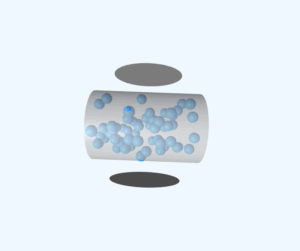
Cricket Ball & Bat Physics Simulation
Ball Properties
Bat Properties
Simulation Controls
Example
Question:
(a) When a molecule (or an elastic ball) hits a (massive) wall, it rebounds with the same speed. When a ball hits a massive bat held firmly, the same happens. However, when the bat is moving towards the ball, the ball rebounds with a different speed. Does the ball move faster or slower?
(b) When gas in a cylinder is compressed by pushing in a piston, its temperature rises. Explain in terms of kinetic theory using (a).
(c) What happens when a compressed gas pushes a piston out and expands? What would you observe?
(d) Sachin Tendulkar used a heavy cricket bat while playing. Did it help him in any way?
Solution:
(a) Let the speed of the ball be \(u\) relative to the wicket behind the bat. If the bat is moving towards the ball with speed \(V\) (relative to the wicket), then the ball's speed relative to the bat is \(V+u\). After rebounding, its speed relative to the bat is also \(V+u\) away from the bat. Therefore, relative to the wicket, the speed of the rebounding ball is \(V + (V + u) = 2V + u\) moving away from the wicket. So the ball speeds up after the collision with the bat. If the bat is not massive, the rebound speed is less than \(u\). For a molecule, this means an increase in temperature.
(b) When gas is compressed by a piston, the piston is analogous to the moving bat. Molecules rebound with increased speed, increasing the temperature of the gas.
(c) When compressed gas pushes a piston and expands, energy is transferred from gas to piston; molecules rebound with less speed, and the gas cools.
(d) A heavy cricket bat acts like a massive wall. The rebound speed will be higher, helping to play more forceful shots.
Hint: piston → bat, cylinder → wicket, molecule → ball.
Physics Explanation
When a ball with speed u hits a massive bat moving towards it with speed V, the relative speed is V + u. After the elastic collision, the ball rebounds with speed V + u relative to the bat. From the ground's perspective, the ball's new speed is 2V + u.
This explains why heavy cricket bats are advantageous - they transfer more energy to the ball. Similarly, when gas molecules hit a moving piston (analogous to the bat), their speed increases, resulting in temperature rise during compression.
Calculated rebound velocity: 0 m/s